


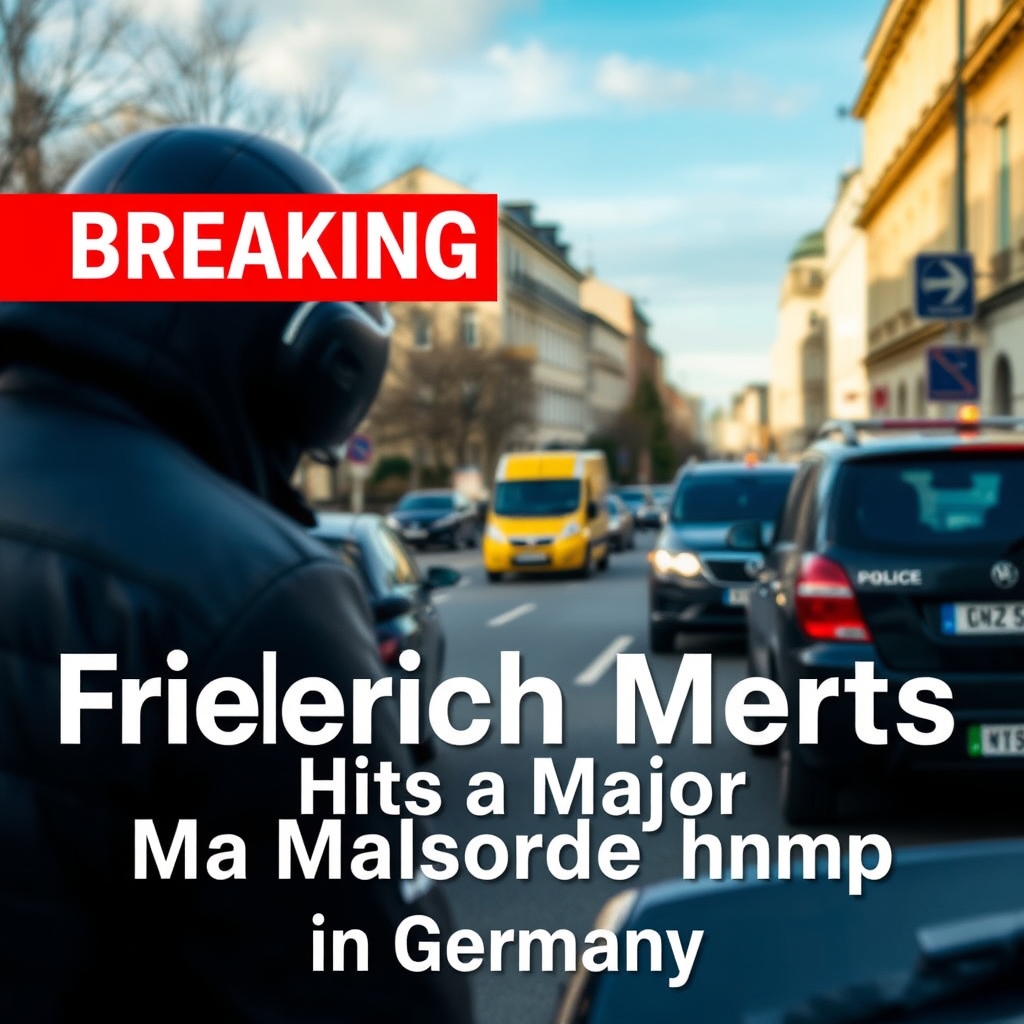
Friedrich Merz, the center-right candidate for German Chancellor, faced a brutal reality check early Monday morning after his party suffered a crushing blow in the latest round of state elections. The results in the regional vote were nothing short of a wipeout for his conservative coalition, leaving the political establishment in Berlin reeling as they try to process the fallout from a restless electorate.
This wasn't just a bad night at the office; it was a total gut punch that has sent shockwaves through the Bundestag. Merz, never one to mince words, didn't try to sugarcoat the outcome. He stepped in front of the press and labeled the performance a disaster for the Christian Democratic Union, acknowledging that his party’s traditional base is fracturing in ways we haven’t seen in decades.
To understand why this stings so much, you have to look at the numbers. The CDU, which once held a ironclad grip on these districts, saw its support evaporate as voters defected to fringe parties on both the far-left and far-right. It’s the kind of political turbulence that makes the NFL’s off-season coaching carousel look stable by comparison. The central question now isn’t just about the vote tally; it’s about whether Merz has the juice to keep his party from folding under the pressure before the national elections roll around.
[MYSTERY DECODED]: The curious case of the disappearing center.
Why is the German political machine suddenly sputtering? For years, the country operated under a reliable, predictable consensus. You had the conservatives on one side and the center-left on the other, with a few smaller parties acting as tie-breakers. It was a well-oiled engine, and everyone knew the drill. But lately, the math just isn't adding up. We’re looking at a structural failure in the democratic process where the traditional middle-ground is being hollowed out, replaced by a polarized mess that’s difficult to govern.
When you look at the district-by-district maps, the puzzle becomes even more bizarre. You see rural areas—places that have backed the same party for forty years—suddenly flipping to radical outsider platforms in a single election cycle. It defies the standard model of voter behavior. Scientists and political analysts call this "voter volatility," but that’s just a fancy way of saying nobody knows what’s going on. We are watching a total migration of the electorate that has left the experts scratching their heads.
The tech side of this is even murkier. Algorithms on social media platforms have hyper-targeted these voters, pushing them into echo chambers where the CDU’s traditional talking points simply don't land. It’s a digital feedback loop that turns local grievances into national firestorms. By the time the parties realize the wind has changed direction, it’s already too late. The mystery isn't just why the CDU lost; it’s why they were completely blind to the fact that their own voters were clicking "unsubscribe" on their message.
Merz is now in a precarious spot, sitting at the head of a party that feels more like a house divided. He’s vowed to stay on, planting his flag in the ground and telling the media he’s not going anywhere. But in the high-stakes game of German politics, staying power is usually measured in polling data, not just personal resolve. He’s going to have to pivot, and fast, if he wants to survive the winter.
This isn't just some local squabble happening across the pond; it impacts global trade and the stability of the Western alliance. When Germany catches a political cold, the whole of Europe—and often the White House—ends up feeling the chill. US markets are already keeping a close eye on the value of the Euro, knowing that a fractured German government means less certainty for multinational corporations doing business in the region.
So, what’s the play from here? The CDU leadership is scrambling to organize a damage-control committee. They need to figure out why the party message turned into white noise for the average voter. They’ll likely spend the next month running focus groups and trying to find a new pitch that doesn't sound like a canned speech from a decade ago. It’s a classic re-branding effort, but with the added pressure of having to run a country while you’re fixing your own foundation.
Observers on the ground in Berlin expect a series of heated closed-door meetings in the coming weeks. You can bet that Merz’s rivals within his own party are already sharpening their knives, waiting to see if he manages to right the ship or if he’s just going to sink faster. He’s got the backing of the party bigwigs for now, but in politics, loyalty is a perishable good.
The real test will come during the next round of regional polls. If the numbers don't show an immediate rebound, the talk of a leadership challenge won't be limited to the backrooms—it’ll be front-page news. Merz is betting his entire career that he can be the guy who turns this around, but the clock is ticking and his opponents are ready to pounce.
For the American observer, the takeaway is pretty clear: political stability is no longer a given, even in the most organized democracies. The German experience serves as a warning that shifting economic tides and digital polarization can flip a political landscape on its head overnight. We’re seeing a new, faster, and more aggressive version of civic engagement that leaves very little room for error.
We’re going to be tracking the CDU’s poll numbers through the end of the year to see if the bleeding stops or if this "disaster" was just the opening act. Merz might have the resolve to stay in the game, but he’s currently playing with a deck that’s been thoroughly reshuffled. Whether he can find a winning hand before the national election remains the biggest question in European politics right now. Watch this space, because the fallout from this election is likely to define the continent’s trajectory for the next few years.
In the shadow of the Reichstag, the mood is not one of mourning, but of a frantic, restless recalculation. Local political operatives in the industrial heartlands of North Rhine-Westphalia—once the bedrock of Christian Democratic strength—are reporting a level of voter alienation that transcends traditional economic anxieties. Walk into any cafe in Gelsenkirchen or Essen, and you will hear the same refrain: the political establishment speaks a language of bureaucratic moderation that feels entirely detached from the reality of rising utility costs and the crumbling infrastructure of the local rail network. Merz, long characterized by his crisp, boardroom-style pragmatism, is now being criticized by his own grassroots base for projecting an image of detachment, a coldness that feels like indifference to the blue-collar anxieties gripping the region.
To exacerbate the situation, the internal machinery of the CDU is grinding to a halt. Behind the mahogany doors of the party’s headquarters in the Konrad-Adenauer-Haus, a quiet civil war is brewing between the traditionalist wing, which believes the party must double down on fiscal conservatism to regain credibility, and the pragmatic reformers, who argue that the party’s obsession with historical tropes has blinded it to the need for a modern, identity-driven platform. These factions are currently paralyzed, unable to agree on a coherent policy pivot. Should they lean into the hard-right rhetoric that has been siphoning away their voters in the East, or should they move back toward the center to capture the disaffected moderate liberals currently flirting with smaller coalition partners? Every day spent in this deadlock is a day that the opposition gains ground, positioning themselves as the only alternative that actually listens to the pulse of the street.
Meanwhile, the economic pressure is mounting. The German automotive giants, the titans that once ensured the nation’s political stability through their sheer output and job creation, are signaling distress. With supply chain fractures and the slow transition to electric manufacturing creating profound uncertainty, corporate leaders are looking for a state partner that can provide long-term planning and regulatory clarity. Merz’s current weakness makes him an unreliable partner in their eyes. There is a palpable shift occurring in the boardrooms of Munich and Stuttgart, where executives are beginning to hedge their bets, engaging more frequently with regional political figures rather than the central leadership in Berlin. They are looking for stability where it can be found, even if it means fragmenting the traditional power structures that have guided Germany’s industrial policy for half a century.
The next act in this drama will likely unfold during the upcoming state-level budget deliberations. These sessions, usually routine exercises in fiscal housekeeping, are expected to turn into a theater of confrontation. Opposition leaders are primed to use these debates to expose the fissures within the CDU, forcing ministers to take public stands on policies that divide their caucus. Merz will be forced to choose: keep his coalition partners satisfied or yield to the populist demands of his backbenchers. It is a classic trap, and the outcome will dictate whether he remains a viable chancellor-candidate or becomes a footnote in the history of a party undergoing a painful existential metamorphosis. As the winter sets in and energy concerns dominate the dinner table conversations, the government's ability to maintain public confidence is eroding. The irony is that the more Merz attempts to stabilize the ship by tightening the discipline of his party, the more he risks alienating the very voters who feel that the establishment is tightening its grip instead of solving the problems at hand. The coming months are not just about party loyalty or internal polling; they are about whether the traditional architecture of German governance can survive the weight of its own obsolescence.
written by www.afoxtv.com












Comments
Post a Comment